


From a Private Tour of Lyon to the Pages of a Novel
How Swedish novelist Katarina Bivald came to Lyon looking for inspiration, discovered a red door in Vieux Lyon, and returned two years later to a city she had fallen in love with
Every private tour begins with a city.
The interesting part is discovering which version of that city matters to the person walking beside me.
In 2024, I had a particularly unusual request.
Swedish novelist Katarina Bivald was coming to Lyon. Before our tour, she explained that she was working on a new novel and wanted to explore the city partly as research and inspiration for the book.
That immediately changed the way I approached our visit.
This wasn't simply someone who wanted to see Lyon's monuments. I had a writer looking for material.
So I began looking at my own city through her eyes.
Lyon through the eyes of a writer
A private tour, at least for me, should never mean taking a standard itinerary and simply reducing the number of people.
The person changes the tour.
If someone loves architecture, music, gastronomy, sport or history, I follow those threads. Sometimes they lead us away from the itinerary I had imagined entirely.
With Katarina, one of those threads was obvious: books.
Lyon has an extraordinary relationship with the written word. During the Renaissance, the city became one of Europe's major centres of printing and publishing, a place where printers, booksellers, humanists and ideas circulated across borders.
So I took Katarina to a place that seemed made for a visiting novelist.
The Mur des Écrivains
On rue de la Platière stands an enormous trompe-l'œil mural known as La Bibliothèque de la Cité, or the Mur des Écrivains.
The façade has been transformed into a gigantic library. Bookshelves rise across several floors, filled with works connected to writers from Lyon and the surrounding region.
I had deliberately added it to our visit because Katarina was a writer.
She loved it.
We talked about Lyon's history of printing, books and writers before continuing through the city.
At that point, it was simply another successful detour on a private tour.
I could not know that another place I showed her would have a much longer afterlife.
And this time, it wasn't a wall covered in books.
It was a red door.
The red door at 2 Montée du Gourguillon
Our exploration eventually took us towards Montée du Gourguillon, one of Lyon's oldest and most atmospheric streets.
The steep climb above Saint-Georges preserves something I particularly love about Vieux Lyon: from the street, you can never entirely know what exists behind a door.
At 2 Montée du Gourguillon, I showed Katarina one of those hidden spaces.
The entrance is difficult to forget.
A large red door opens onto an old passageway, with stairs, courtyards and glimpses of the buildings and sky above.
For most visitors, it is another remarkable fragment of historic Lyon.
But Katarina wasn't looking at the city only as a visitor.
She was looking at it as a novelist.
And the red door stayed with her.
Then my tour ended. Her investigation didn't.
A year later, I discovered something wonderful.
Katarina had written publicly about what happened after our visit.
On 13 August 2025, she published an entry on her official website with an irresistible premise:
“I’m looking for a good place to kill someone.”
Fortunately, she meant fiction.
Her next sentence establishes exactly why she had come to Lyon:
“A year ago I traveled to Lyon looking for a good place for my (fictional) murder…”
She explains that instead she discovered a real murder connected to the red door at 2 Montée du Gourguillon. Katarina Bivald
Read Katarina Bivald's original blog post
Suddenly, I could see what had happened after we said goodbye.
The tour had finished.
The writer had kept walking.
A real crime behind the fictional one
During our visit, I had also mentioned another Lyon guide who specialised in the darker side of the city's history.
Katarina followed that lead and investigated further.
The address at Gourguillon turned out to have a disturbing real criminal history associated with it. What had begun as the discovery of an evocative traboule became something considerably darker.
She later wrote about the experience for CrimeReads, describing the silk-weavers' quarter, Lyon's traboules and the macabre story associated with the red door. Her own website explicitly directs readers to that account. Katarina Bivald
But the part that fascinates me most came afterwards.
Katarina returned to Gourguillon alone.
No tour.
No guide.
Just a writer returning to a place that had lodged itself somewhere in her imagination.
She went back through the red door and into the passageway.
Standing in one of its courtyards, looking upwards between the old buildings, she realised that she had found what she needed.
In her CrimeReads account, she describes the moment when she knew this would be the last place one of her characters would ever see.
The transformation was complete.
A real place in Lyon had become a fictional place inside a novel.
From Lyon to Just Another Dead Author
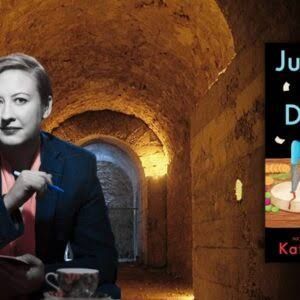
The book eventually appeared in English as Just Another Dead Author, published by Poisoned Pen Press on 12 August 2025. It follows mystery writer Berit Gardner to a writers' conference in the French countryside, where the literary gathering turns into a murder investigation. Sourcebooks
Just Another Dead Author at Sourcebooks / Poisoned Pen Press
I want to be very precise about my part in this story.
I didn't create Katarina's setting.
I didn't discover the criminal case for her.
And I certainly didn't write her novel.
What I did was much simpler.
I showed a writer a door.
I knew she had come to Lyon looking for inspiration, so I adapted the visit accordingly. I showed her the Lyon of books and printers, the Mur des Écrivains, the old streets and hidden passages, and eventually the red entrance at 2 Montée du Gourguillon.
Then curiosity took over.
She investigated.
She returned.
And she transformed what she found into fiction.
For a guide, that is a rather wonderful thing to discover a year later.
Two years later: “Back in Lyon. Finally!”
Then, in September 2026, the story unexpectedly started again.
I opened social media and saw a very familiar building.
The Mur des Écrivains.
Katarina was back in Lyon.
Her message was simple:
“Back in Lyon. Finally!”
That made me smile.
Of all the images she could have chosen to announce her return, there was the enormous painted library I had deliberately shown her in 2024 because she was a writer.
Over the following days, she wandered around Lyon again.
From the Passerelle Saint-Georges, with the Saône and old Lyon behind her, she wrote something even better:
“Lyon! How I love this city.”
For someone who spends his working life trying to make people understand why Lyon is special, it was difficult not to enjoy that.
So I recommended one more door
I sent Katarina a short message welcoming her back.
Then instinct kicked in again.
If she had time, I told her, she should visit Le Bal des Ardents, my favourite independent bookshop in Lyon.
Its entrance is almost an installation in itself: books surround the doorway before the shop disappears into shelves beyond it.
It seemed exactly right for her.
A few days later, Katarina messaged me again.
She had gone.
She loved it.
And then came the perfect little epilogue.
When she published photographs from what she described as fantastic days working and wandering around Lyon, Le Bal des Ardents appeared among them.
So did the Mur des Écrivains.
Two places I had recommended to the same writer, two years apart, had ended up together in the visual diary of her return to Lyon.
Where does a private tour end?
That's what I keep coming back to.
In 2024, Katarina arrived with an unusually clear request.
She was a novelist.
She was writing a book.
She wanted Lyon to inspire her.
My job wasn't to decide what she should find inspiring. It was to know the city well enough to put interesting things in her path.
A Renaissance printing city.
A giant painted library.
A centuries-old neighbourhood.
A hidden passage.
A red door.
What she did with those ingredients belonged to her.
One of them eventually crossed from the physical city into fiction.
Two years later, she returned to Lyon. The painted library appeared again. I suggested another door, this time leading into a bookshop.
She walked through that one too.
There is a temptation in tourism to describe a private tour through numbers: two hours, three hours, ten monuments, fifteen stops.
I think about it differently.
A city contains millions of possible details. The guide's real job is to understand which ones might matter to the person walking beside him.
Sometimes it is Roman history.
Sometimes food, architecture, wine or music.
Sometimes it is a wall covered in books.
And sometimes it is a red door that eventually finds its way into a novel.
Perhaps that's what I love most about guiding: you never really know where a tour ends.
Refine the finished Lyon story